
With Emphasis on Violence Against Women and Children and the Perspective of Johan Galtung
Introduction
Peace has long been considered one of humanity’s most essential aspirations. With the development of scholarship in International Relations, the meaning of peace has expanded far beyond the traditional idea of simply ending war. Today, peace is increasingly understood as a multidimensional concept that includes social justice, human security, and human dignity.
Within this broader understanding, greater attention has been given to the condition of vulnerable groups, especially women and children. Evidence shows that even in the absence of armed conflict, women and children often continue to face different forms of violence. For this reason, any serious discussion of peace must include an examination of violence against women and children. In this context, the work of Johan Galtung provides one of the most important theoretical foundations for understanding peace in a deeper and more complete way.
1.The Concept of Peace and Its Connection to Violence Against Women and Children
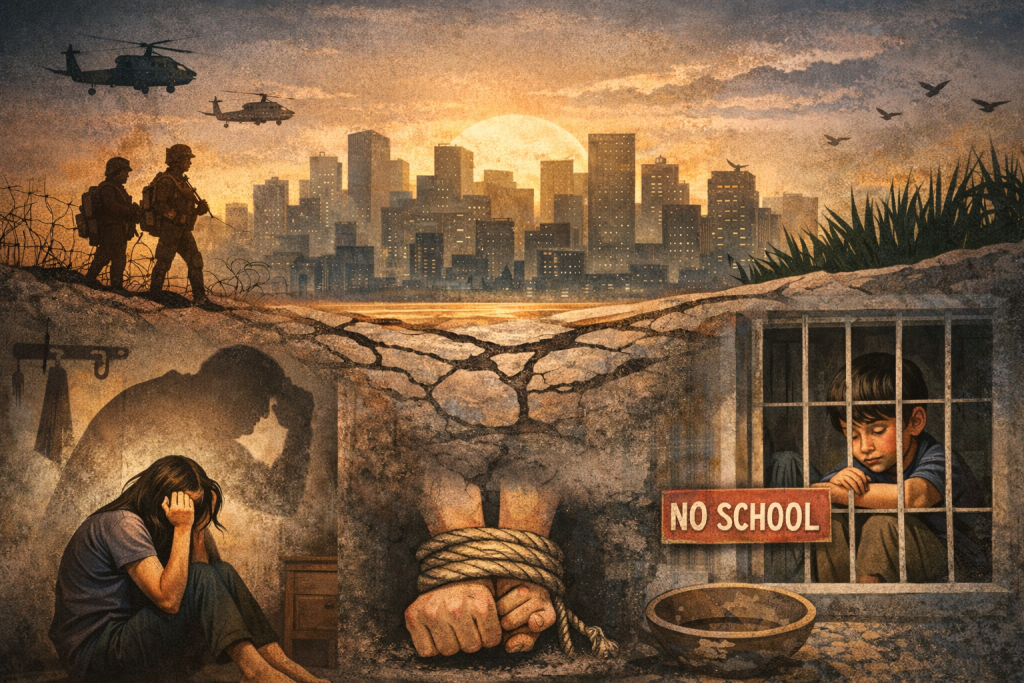
Traditionally, peace has been defined as the absence of war and direct violence. However, this narrow definition does not reflect the realities of many contemporary societies. In numerous contexts, there may be no war, yet violence against women and children still persists in many forms, including domestic abuse, forced marriage, child labor, sexual exploitation, denial of education, and systemic discrimination.
From a broader perspective, peace should be understood as a condition in which women are protected from all forms of violence and discrimination, children are guaranteed basic rights such as education, healthcare, and safety, and social and institutional systems prevent the continuation of inequality.
Therefore, any meaningful understanding of peace remains incomplete if it does not address the structural and cultural roots of violence against women and children.
2-Positive and Negative Peace in Relation to Women and Children
The distinction between positive peace and negative peace, introduced by Johan Galtung, is one of the most important contributions to peace studies. It helps explain why the absence of war alone is not enough to describe a truly peaceful society.1
2.1 Negative Peace
Negative peace refers to the absence of direct violence or armed conflict. In such a situation, open warfare may be absent and a level of visible stability may exist.
However, this does not mean that justice has been achieved. Domestic violence against women may still continue. Children may still face exploitation, abuse, neglect, or exclusion. Structural inequalities based on gender and age may also remain deeply rooted in society.
For this reason, negative peace represents only a minimal and fragile form of peace. It may reduce visible conflict, but it does not guarantee genuine human security or dignity.
2.2 Positive Peace
Positive peace goes beyond the mere absence of violence. It refers to the removal of the root causes of violence and the creation of fair, just, and inclusive social conditions.
In a state of positive peace, women enjoy equal rights and opportunities, children grow up in safe and supportive environments, and legal and institutional frameworks actively protect vulnerable groups. Positive peace can only be achieved when structural injustice and cultural forms of violence are addressed and eliminated.
Approaches to Peace and Their Engagement with Violence Against Women and Children
Different theoretical approaches in International Relations offer different understandings of peace. Each approach places emphasis on particular dimensions of security, justice, and social order.
3.1 Realist Approach
The realist approach understands peace mainly in terms of the balance of power between states. It prioritizes national security, state survival, and strategic stability. In this framework, peace is often seen as a temporary outcome of power relations.
Because realism focuses primarily on interstate relations, it tends to overlook internal social problems, including violence against women and children.
3.2 Liberal Approacha
The liberal approach emphasizes democracy, international institutions, cooperation, and the protection of human rights. Compared to realism, it offers more space for discussing the welfare and rights of individuals, including women and children.
Even so, liberal approaches often remain focused on relations among states and may not always address domestic violence and social inequality in sufficient depth.
3.3 Critical and Feminist Approaches
Critical and feminist approaches make an essential contribution to peace studies by exposing the structural nature of violence. These perspectives argue that violence is embedded in systems of power, exclusion, and inequality.
They identify gender-based violence as a major obstacle to peace and insist that sustainable peace is impossible without gender equality, justice, and the transformation of unequal social relations.
3.4 Cultural Approach
The cultural approach highlights the role of values, beliefs, norms, and traditions in shaping attitudes toward violence and peace. Some cultural practices may normalize, justify, or hide violence against women and children.
This approach emphasizes that education, awareness, and cultural transformation are necessary for building a genuine culture of peace.
4.Theories of Peace and Their Limitations Regarding Vulnerable Groups
Major theories of peace, such as Democratic Peace Theory, Interdependence Theory, and Collective Security Theory, have contributed significantly to the understanding of how large-scale wars can be prevented. However, these theories often focus mainly on relations between states and pay less attention to violence within societies.
Yet the continued existence of violence against women and children is itself a clear sign that genuine peace has not been achieved. A comprehensive theory of peace must therefore address both international conflict and domestic injustice.
5.Johan Galtung’s Perspective and the Analysis of Violence
Johan Galtung is widely regarded as one of the most influential scholars in peace studies. His framework provides a deeper and more comprehensive way of understanding both violence and peace.
5.1 Forms of Violence
Galtung identifies three interconnected forms of violence.
Direct violence refers to visible physical harm, such as abuse, assault, and other forms of direct aggression against women and children.
Structural violence refers to systemic inequality embedded in institutions and social arrangements, such as gender discrimination, poverty, and unequal access to education and opportunities.
Cultural violence refers to beliefs, traditions, narratives, and values that justify or normalize violence and discrimination.
5.2 The Triangle of Violence
According to Galtung, these three forms of violence are closely connected and reinforce one another. Women and children are often disproportionately affected because structural inequality increases their vulnerability, cultural norms may justify discrimination, and direct violence appears in physical or psychological forms.
This interconnected model is often described as the triangle of violence.
5.3 Positive Peace and the Protection of Vulnerable Groups
In Galtung’s framework, real peace requires the elimination of all forms of violence, not just direct physical conflict. Gender equality is a central pillar of peace, and the protection of children’s rights is an essential condition for building a peaceful and sustainable society.
5.4 Conflict Transformation
Galtung does not focus only on conflict management. He argues for conflict transformation, which means addressing the root causes of conflict, reforming unjust social structures, and building relationships based on equality, dignity, and mutual respect.
Conclusion
Peace is a complex and dynamic concept that goes far beyond the absence of war. The distinction between positive and negative peace shows that genuine peace requires the removal of the structural and cultural causes of violence.
Violence against women and children reveals the limitations of narrow definitions of peace. Although different theoretical approaches offer useful insights, Johan Galtung’s framework provides a more complete understanding by connecting peace with justice, equality, and the elimination of all forms of violence.
Ultimately, sustainable peace can only be achieved when all members of society, especially women and children, are able to live in conditions that are safe, just, and free from violence.